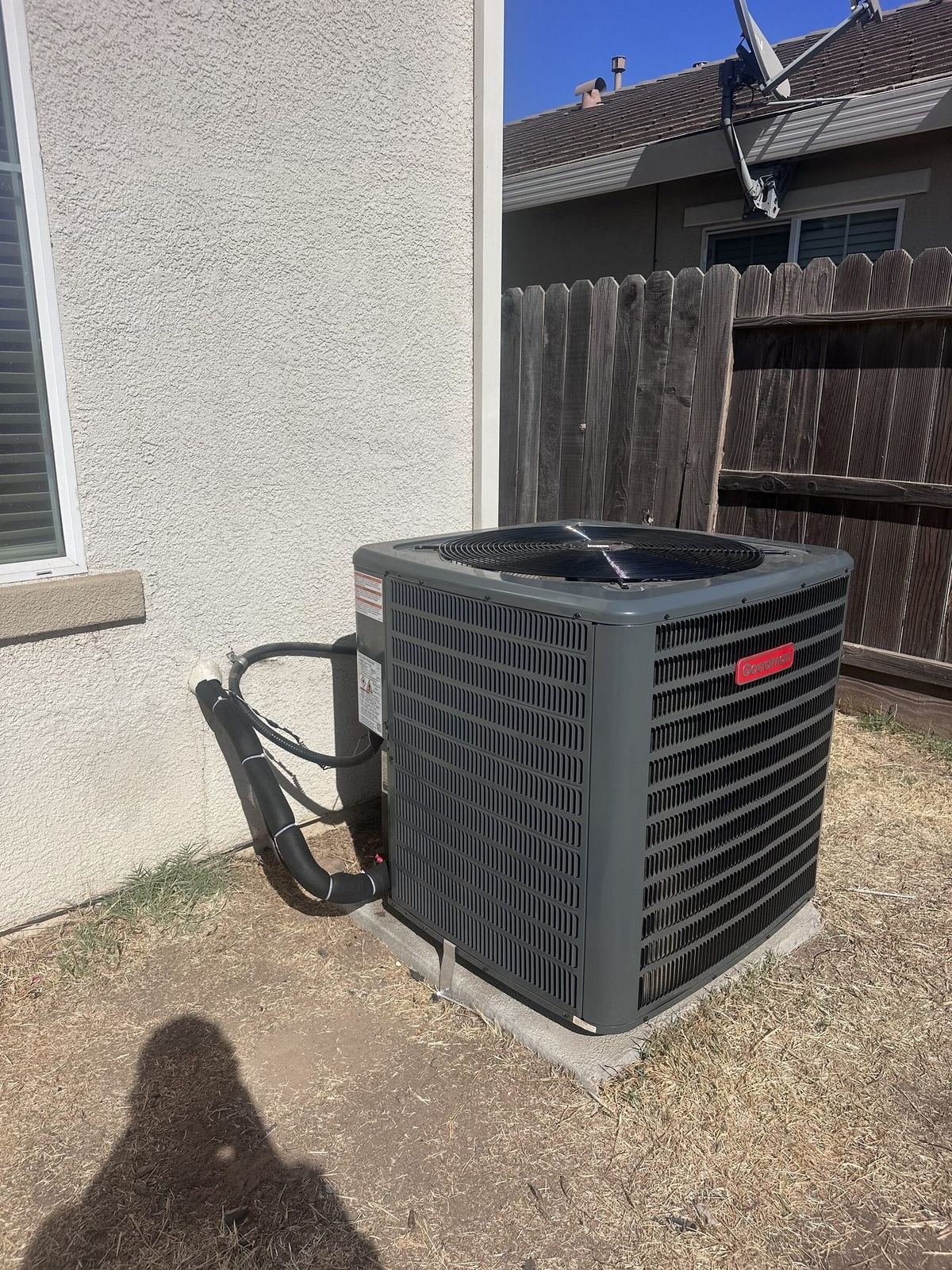
Air conditioning is a sealed system. It does not use refrigerant up, so refrigerant that has gone has escaped somewhere — and finding where is cheaper than paying for it again next year.
Flat-rate, approved firstYou see the price before we start
Open 24/7Nights, weekends, holidays
What you are seeing
Six signs a system is losing refrigerant
The symptoms that bring most people to this page, and what each one usually means.
It cools, but not like it used to
The most common first sign. The system still runs and still blows cold, it just never quite gets the house down any more, and it runs longer trying.
Longer run times
Never quite catches up
Ice on the copper line or the coil
Low refrigerant drops the coil temperature below freezing and moisture freezes onto it. Ice on an air conditioner in July is one of the clearest signs there is.
Ice on the lineset
Frost on the indoor coil
It needed refrigerant last summer too
This is the one that matters. A sealed system does not use refrigerant the way a car uses fuel. If it needed a top-up last year and needs one again, the refrigerant is going somewhere.
Topped up before
Same problem returning
Hissing or bubbling from the system
An audible hiss near the indoor coil or the lineset can be refrigerant escaping through a larger leak. It is worth mentioning when you call.
Hissing near the coil
Bubbling sounds
The compressor is struggling or cutting out
Running low on refrigerant makes the compressor work hot and hard. Left long enough that turns a repair into a replacement, which is why topping up and waiting gets expensive.
Hard starts
Cutting out on a hot day
Higher bills with no other explanation
A system short on refrigerant runs far longer each day for the same result, and the meter is the first place most people notice.
Bills up year over year
Runs most of the afternoon
Why it matters
Why topping it up gets expensive
Adding refrigerant is quick and it works, right up until the following summer. Here is what that cycle actually costs.
A top-up is not a repair
Air conditioning is a sealed system. It does not consume refrigerant, so any that has gone has escaped through a hole. Adding more without finding that hole buys a season at most, and you pay for the refrigerant again next year.
Refrigerant is the expensive part
Especially on older R-22 systems, where the refrigerant has been phased out and what remains is costly. Two or three top-ups often add up to more than finding and fixing the leak would have.
Running low damages the compressor
Low charge makes the compressor run hot. The compressor is the single most expensive component in the system, and replacing one on an older unit is usually the point where replacement wins outright.
Finding it first changes the advice
Where the leak is decides whether this is a straightforward repair or a conversation about replacing the system. A leaking service valve and a leaking evaporator coil are very different jobs, and you deserve to know which one you have before you spend anything.
Tell us what the system is doing and whether it has been topped up before. Pick the office nearest you and we will come and locate it.
The leak located, not guessed at
Flat-rate pricing you approve before we start
One-year warranty on our work
Turlock(209) 595-9367
Modesto(209) 486-2133
Request an appointment
How the job goes
Four steps from diagnosis to a sealed system
01
Find the leak
A leak has to be located before it can be fixed. That means checking the lineset, the service valves, the brazed joints, the condenser coil and the evaporator coil until the source is identified rather than guessed at.
02
Fix what is leaking
Many leaks are at joints, valves or a section of line, and those are ordinary repairs. Coils are a bigger job, and on an older system that is the point where we put repair and replacement numbers side by side.
03
Charge it properly afterwards
A repaired system is evacuated and charged to the manufacturer’s spec rather than topped up until it feels about right. Getting the charge wrong costs efficiency and shortens the life of the compressor.
04
The repair price is agreed before we open the system
You see the price for the repair before anything comes apart, and our work carries a one-year warranty on top of any manufacturer coverage.
⭐⭐⭐⭐⭐ Outstanding Service – Highly Recommend!
I had an excellent experience with HVAC Penguin! From start to finish, the service was nothing short of exceptional. He was extremely knowledgeable, punctual, professional, and efficient. He arrived right on time, knew exactly what he was doing, and got the job done quickly without compromising the quality of his work. It's refreshing to find someone who truly knows their trade, respects your time, and delivers outstanding customer service. Reliable, honest, and professional—exactly what you want when hiring someone! I highly recommend HVAC Penguin and would absolutely use their services again!
We called Eric to repair our heater and he was at the house in 40 minutes! A life saver , he was able to diagnose and fix the problem in no time …. and he gave us good maintenance tips as well ! We’ll call him again for service when needed …
Thanks Eric !
My Ac stopped running in peak summer and HVAC Penguin responded really quickly and got my AC running in no time. Would highly recommend to anybody needing there hvac system serviced or repaired.
Excellent service from start to finish! Great pricing, fast response, and quality work. They were professional, efficient, and made the whole process easy and stress-free. It’s hard to find reliable HVAC service at such a reasonable price. Highly recommend to anyone looking for honest, affordable, and dependable HVAC services!
5/5 Stars – Outstanding Service & True Professionals!
I had a fantastic experience working with HVAC Penguin! Their team arrived right on time, conducted a thorough assessment of our system, and explained everything clearly without pushing unnecessary upsells. The technicians were friendly, professional, and kept the work area completely clean. Our system is running smoother and quieter than ever. Highly recommend HVAC Penguin to anyone needing trustworthy heating and cooling service!
Technician that came to service our AC unit was very helpful. Also communicated very clearly on what was needed. And was able to get it running same day
Our AC stopped working on one of the hottest days and I called HVAC Penguin. They were able to get someone out pretty quick and got the AC back up and running the same day. Really appreciated that they actually took the time to show me what went wrong and what they fixed. No pressure or trying to sell me a whole new system which has happened to us before. If you’re looking for a good AC company in Modesto I would definitely give them a call.
Eric has worked at my house and business. Both times he has been on time and very professional. Gave me an honest quote and took care of both issues as soon as possible. He was also very flexible with our schedule. Would recommend this company 10000%
I had a damper issue. Where half of the house was freezing and other half warm. Couldn't get it to work and cool each half as desired. Eric did a great job explaining everything he found that needed to be corrected, repaired or cleaned. He answered all questions respectfully and with details. Left no mess behind and guaranteed his work. Would definitely recommend.
I had Eric from HVAC Penguin install a split AC in my garage in Patterson as my garage could be in the high 90’s
Eric came in with a very reasonable quote, and was able to do a full install in 1 week which took 1dsy which included electrical and running 40+ feet of AC line in the attic to the outside compressor. The work is flawless.
The AC cools my garage. I have an electric car which can generate some heat when charging. With the AC running my car can take a full charge in 2hrs where before without AC in a hot garage it took just under 3hrs
If you need a AC installed or repairs on your system I highly recommend Eric and HVAC Penguin
Because it is leaking. Air conditioning is a sealed system — it does not use refrigerant up the way a car uses fuel, so refrigerant that has gone has escaped somewhere. A system that needed a top-up last summer and needs one again has a leak that has not been found yet.
Adding refrigerant will get you cooling again, and sometimes that is the right call in the middle of a heat wave. It is worth knowing it buys a season rather than solving anything, and that the refrigerant is the expensive part — which is why we would rather find the leak for you.
By working through the places they happen: the lineset, the service valves, the brazed joints, the condenser coil and the evaporator coil. The point is to identify the actual source rather than guess, because where the leak is determines whether this is a small repair or a bigger decision.
It depends entirely on where the leak turns out to be. A valve or a joint is a straightforward repair; an evaporator or condenser coil is a bigger job. We charge a flat diagnostic fee to find it, then give you a flat-rate price for the repair that you approve before any work starts.
Sometimes, and sometimes not. R-22 was phased out, so the refrigerant itself is expensive and getting more so. If the leak is at a joint or a valve the repair can still make sense. If it is in a coil, the cost of the repair plus the refrigerant usually points toward replacement, and we will show you both numbers.
The bigger risks are to the equipment and your bills rather than to your household. Running low on charge makes the compressor work hot, and the compressor is the most expensive part of the system. That is the real reason not to leave a leak unfixed through another summer.
It can, if the system is still inside its manufacturer warranty and the failed part is covered. We will check the model and the registration while we are there and tell you what applies.
Our Turlock office at 7207 West Main Street, on (209) 595-9367, covers Turlock, Denair, Hilmar, Delhi, Keyes, Hughson, Ballico, Livingston, Stevinson, Winton, Crows Landing, Patterson and Newman. Our Modesto office at 509 Winmoore Way, Suite D, on (209) 486-2133, covers Modesto, Salida, Riverbank, Oakdale, Ceres, Empire, Waterford, Ripon, Escalon, Del Rio, Grayson and Manteca. Each office keeps its own crew and its own schedule.
Ready when you are
Stop paying for the same refrigerant twice
We locate the leak, show you the repair price before we start, and put replacement numbers beside it when that is the better buy.